Musings on life, the universe and everything - including the English and German languages - by a Welshie in Germany.
Friday, January 3, 2025
Frohes Neues Jahr! - Or maybe not, then
Thursday, December 26, 2024
I seem to have moved country
Sunday, December 15, 2024
Bootlaces are not an optional accessory
Recently, I've started going ice-skating again. This entails a 30-minute cycle to get to the ice rink and a half-hour bike ride back home again, with 60 minutes on the ice sandwiched in between.
I've had my own ice skates ever since I took lessons in London many years ago. One thing we learnt was that you have to lace up your boots so that they fit snuggly all the way up the ankle. You might get away with leaving the last pair of hooks at the top unused, but basically, once you've tightened the laces around the foot, you pull them tightly around the hooks of the bit of the boot that goes upwards. The main thing is that your boot grips around your leg.
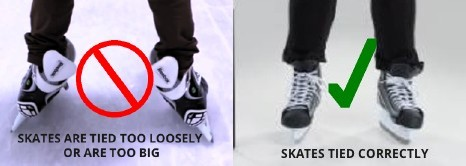
When I'm on the ice, though, what do I see? I see teenagers who think that they can do up ice-skating boots the same way as they do their trainers: they don't lace their boots at all. They sort of wind them round the bottom of the ankle, not using the hooks at all. And then they wonder why they wobble so much, why their feet are at an angle to the ice instead of being upright.
When I see teenagers with badly laced boots, I want to go up to them and tell them what to do so that they'll feel more secure on the ice, but then I restrain myself as I've been told I shouldn't "poke my nose into other people's lives" and I let them get on with it. But I do feel sorry for them. If only they could figure out for themselves that those long laces and the hooks on the boots are actually there for a purpose and aren't an optional accessory.
This is how boots shouldn't and should look like:
Tuesday, December 10, 2024
Like living in a black-and-white film
These days, even in the summer, when I am out and about, walking through the streets, I sometimes think that I must have some sort of eye defect, because I seem to be living in a monochrome world: everyone is dressed in black. From head to toe. Even small children. (No kidding!) Even at the height of the summer.
And I wonder to myself what is wrong with wearing, say, a splash of blue, orange, red or green? Personally, I would rather die than wear a black anorak. All mine are red, because when the days are gloomy, you don't want to pile gloom upon gloom and just wear the most dismal colour around. You want something a bit uplifting, a dash of something bright and cheerful. At least, I do.
Some people tell me that black doesn't show up the dirt, but there are plenty of things that will show up on a black anorak, such as bird poo and ice-cream, to mention but two.
It was similar in the City of London, when I used to pass through it on my way to work: everyone was wearing sombre suits, but at least there was some colour variation - not just black, but dark grey, medium to light grey and navy blue. All pepped up with white shirts or blouses and, for the men, a tie. But even then, I did think they looked like a bunch of crows.
These days, though, people seem to clad themselves in black in some sort of attempt to be self-effacing, to disappear into the background, to not be seen. I presume this from the fact that not only do they wear black, but they wear the most shapeless clothes around, baggy to the extreme. Like some human Shar-Pei, a dog famed for having more skin than is necessary for its actual frame.
I miss the days when people dressed with some style and panache. With colour and an eye for what went well together. Nowadays, I walk along the streets with dark-clothed, shapelessly clad people that put me in mind of slugs and I think that I'm in some parallel universe, one that is a black-and-white movie from the time when Technicolour film had not been invented.
If there is one thing that the film The Wizard of Oz, a movie that is always shown on UK TV at Christmas time, and whose middle section is in glorious Technicolour, should have taught us over the years, it is that colour is something fantastic, joyous and uplifting. How sad that people have turned their backs on bright and joyful colours.
Tuesday, November 26, 2024
The advantage of the "Sie" form when learning German
Now, as you may know, when you learn a foreign language, that is probably the first time you come across the word "to conjugate". That means you have to change the form of the verb according to the subject that is placed in front of it. English is a nice language in that there are only a few occasions when the basic form of the verb, i.e. the infinitive, changes in any way. Mostly, it's a case of sticking a 's' onto the end of the verb with he, she or it. (As the Germans like to say: he, she, it - ein S muss mit.) Have has the form 'has' for the third person singular and it's only really the verb 'to be' that has three different forms (am, is, are).
German, however, has a different ending for each person. The verb for 'to go', gehen, is conjugated thus:
ich gehe (I go)
du gehst (you go - informal you, singular form)
er/sie/es geht (he/she/it goes)
wir gehen (we go)
ihr geht (you go - informal you, plural form)
Sie gehen (you go - formal you, plural and singular form)
sie gehen (they go)
[When my Japanese friend realised there were three uses of "sie" (with and without a capital S) as the subject of a sentence, she gave up learning German, but that's just en passant.]
As you may have noticed, however, the form of the verb for the polite you form, Sie, is the same as the infinitive, which is why, when I first started to learn German formally at nearly the age of 14, I promptly addressed even family members using the "Sie" form, because then I didn't have to think about conjugating the verb. It gave them a jolt, I can tell you. "Don't call me "Sie"!" they'd exclaim. But it was so much easier for a learner of German.
Naturally, a language wouldn't be a language if there weren't any exceptions and there is one: it's the verb for 'to be' - sein.
It goes thus:
ich bin
du bist
er/sie/es ist
wir sind
ihr seid (now that's a difficult one to master)
Sie sind
sie sind
People always say that German is a difficult language, but when you compare it to Spanish and French, it's the only one of the three that has infinitives that is the same form as the polite you - which is fine, as it's going to take a while before a German allows you to call them by the informal you.
Monday, November 18, 2024
One advantage of the "Sie" form at work
As I have already said, the Germans set clear boundaries between their working life and their private life. They don't generally socialise with their colleagues.
This means that, even though they may have been working opposite someone else in their little shared office for 20 years or more, they will still call each other Herr Schmidt and Frau Meyer. And they will normally say "Sie" to each other, i.e. the formal version of the word "you".
And why is this an advantage? I'll tell you why. It forms a sort of "wedge" between you and your colleague. It's a sort of barrier, across which you simply do not step. It keeps your colleague firmly at arm's length, which means that when they ask you for a "favour", then it's much easier to say no. You don't feel guilty if you turn down their request, not like you would if you were using the more familiar form of the word for "you" (i.e. "du").
It's very liberating - this feeling of not "owing" something to a fellow worker at your company or institution. You are not a "workmate", you don't feel chummy with them, you know they won't be moaning at you over a pint down at the pub after work because you don't socialise with them - so you don't feel bad at saying no.
German might be an unwieldy language, but it does have some advantages.
Thursday, November 14, 2024
The "Hamburger Sie" and the "Münchener Du"
I capitulate!
You may have read in the press, heard on the radio or seen on TV that Europe is suffering from a so-called "heat dome". Germany ha...
-
Thanks to my reading of some UK newspapers online, the new daily word game called Wordle has come to my intention. A German student of mine ...
-
To kill some time before my Saturday morning massage appointment, I nipped into the German library to read the papers and was stunned to rea...
-
Every now and then, the Daily Mail has an article on some poor British pupil who has been sent home because their hair is too short, their s...