Thursday, December 26, 2024

I seem to have moved country

Recent visits to the Altstadt of this town - or any street between the old part of town and the main station - always make me think that I'm now living in another country, that I've moved out of Germany. And why do I get that impression? Because all I can hear the people around me speak is Dutch. 

Last week, I walked along the Rhine from the Altstadt to the northernmost district of this town (from my flat to there - 14.7 km) and I counted 21 coaches in one car park on the river, and most of them from the Netherlands. 

Now, if you think that Germans are tall (you generally have to raise your eyes to look straight at their face), then you've not seen the Dutch. When speaking to them, you have to flip your head back; they are at least a head taller than the Germans. 

Even today, on Boxing Day, with all the shops closed, the centre of town was still flooded with tall Dutchmen and Dutch women strolling around.

As soon as the Christmas markets close, things will go back to normal, and I'll hear mostly Turkish, Arabic, Spanish and Russian again.


Sunday, December 15, 2024

Bootlaces are not an optional accessory

Recently, I've started going ice-skating again. This entails a 30-minute cycle to get to the ice rink and a half-hour bike ride back home again, with 60 minutes on the ice sandwiched in between.

I've had my own ice skates ever since I took lessons in London many years ago. One thing we learnt was that you have to lace up your boots so that they fit snuggly all the way up the ankle. You might get away with leaving the last pair of hooks at the top unused, but basically, once you've tightened the laces around the foot, you pull them tightly around the hooks of the bit of the boot that goes upwards. The main thing is that your boot grips around your leg.

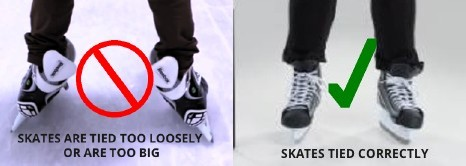
When I'm on the ice, though, what do I see? I see teenagers who think that they can do up ice-skating boots the same way as they do their trainers: they don't lace their boots at all. They sort of wind them round the bottom of the ankle, not using the hooks at all. And then they wonder why they wobble so much, why their feet are at an angle to the ice instead of being upright. 

When I see teenagers with badly laced boots, I want to go up to them and tell them what to do so that they'll feel more secure on the ice, but then I restrain myself as I've been told I shouldn't "poke my nose into other people's lives" and I let them get on with it. But I do feel sorry for them. If only they could figure out for themselves that those long laces and the hooks on the boots are actually there for a purpose and aren't an optional accessory.

This is how boots shouldn't and should look like:


Tuesday, December 10, 2024

Like living in a black-and-white film

These days, even in the summer, when I am out and about, walking through the streets, I sometimes think that I must have some sort of eye defect, because I seem to be living in a monochrome world: everyone is dressed in black. From head to toe. Even small children. (No kidding!) Even at the height of the summer.

And I wonder to myself what is wrong with wearing, say, a splash of blue, orange, red or green? Personally, I would rather die than wear a black anorak. All mine are red, because when the days are gloomy, you don't want to pile gloom upon gloom and just wear the most dismal colour around. You want something a bit uplifting, a dash of something bright and cheerful. At least, I do. 

Some people tell me that black doesn't show up the dirt, but there are plenty of things that will show up on a black anorak, such as bird poo and ice-cream, to mention but two.

It was similar in the City of London, when I used to pass through it on my way to work: everyone was wearing sombre suits, but at least there was some colour variation - not just black, but dark grey, medium to light grey and navy blue. All pepped up with white shirts or blouses and, for the men, a tie. But even then, I did think they looked like a bunch of crows.

These days, though, people seem to clad themselves in black in some sort of attempt to be self-effacing, to disappear into the background, to not be seen. I presume this from the fact that not only do they wear black, but they wear the most shapeless clothes around, baggy to the extreme. Like some human Shar-Pei,  a dog famed for having more skin than is necessary for its actual frame.

I miss the days when people dressed with some style and panache. With colour and an eye for what went well together. Nowadays, I walk along the streets with dark-clothed, shapelessly clad people that put me in mind of slugs and I think that I'm in some parallel universe, one that is a black-and-white movie from the time when Technicolour film had not been invented.

If there is one thing that the film The Wizard of Oz, a movie that is always shown on UK TV at Christmas time, and whose middle section is in glorious Technicolour, should have taught us over the years, it is that colour is something fantastic, joyous and uplifting. How sad that people have turned their backs on bright and joyful colours.


Tuesday, November 26, 2024

The advantage of the "Sie" form when learning German

 Now, as you may know, when you learn a foreign language, that is probably the first time you come across the word "to conjugate". That means you have to change the form of the verb according to the subject that is placed in front of it. English is a nice language in that there are only a few occasions when the basic form of the verb, i.e. the infinitive, changes in any way. Mostly, it's a case of sticking a 's' onto the end of the verb with he, she or it. (As the Germans like to say: he, she, it - ein S muss mit.) Have has the form 'has' for the third person singular and it's only really the verb 'to be' that has three different forms (am, is, are).

German, however, has a different ending for each person. The verb for 'to go', gehen, is conjugated thus:

ich gehe            (I go)
du gehst            (you go - informal you, singular form)
er/sie/es geht    (he/she/it goes)

wir gehen        (we go)
ihr geht            (you go - informal you, plural form)
Sie gehen        (you go - formal you, plural and singular form)
sie gehen        (they go)

[When my Japanese friend realised there were three uses of "sie" (with and without a capital S) as the subject of a sentence, she gave up learning German, but that's just en passant.]

As you may have noticed, however, the form of the verb for the polite you form, Sie, is the same as the infinitive, which is why, when I first started to learn German formally at nearly the age of 14, I promptly addressed even family members using the "Sie" form, because then I didn't have to think about conjugating the verb. It gave them a jolt, I can tell you. "Don't call me "Sie"!" they'd exclaim. But it was so much easier for a learner of German.

Naturally, a language wouldn't be a language if there weren't any exceptions and there is one: it's the verb for 'to be' - sein.

It goes thus:

ich bin
du bist
er/sie/es ist

wir sind
ihr seid (now that's a difficult one to master)
Sie sind
sie sind

People always say that German is a difficult language, but when you compare it to Spanish and French, it's the only one of the three that has infinitives that is the same form as the polite you - which is fine, as it's going to take a while before a German allows you to call them by the informal you.

Monday, November 18, 2024

One advantage of the "Sie" form at work

 As I have already said, the Germans set clear boundaries between their working life and their private life. They don't generally socialise with their colleagues. 

This means that, even though they may have been working opposite someone else in their little shared office for 20 years or more, they will still call each other Herr Schmidt and Frau Meyer. And they will normally say "Sie" to each other, i.e. the formal version of the word "you".

And why is this an advantage? I'll tell you why. It forms a sort of "wedge" between you and your colleague. It's a sort of barrier, across which you simply do not step. It keeps your colleague firmly at arm's length, which means that when they ask you for a "favour", then it's much easier to say no. You don't feel guilty if you turn down their request, not like you would if you were using the more familiar form of the word for "you" (i.e. "du"). 

It's very liberating - this feeling of not "owing" something to a fellow worker at your company or institution. You are not a "workmate", you don't feel chummy with them, you know they won't be moaning at you over a pint down at the pub after work because you don't socialise with them - so you don't feel bad at saying no. 

German might be an unwieldy language, but it does have some advantages.

Thursday, November 14, 2024

The "Hamburger Sie" and the "Münchener Du"

As you probably know, German, like many other languages, has two words for saying 'you'. Well, three actually if you include the plural form of the informal 'du', which you use to address a person you are on closer terms with. If you don't know the person, or if you have to be more formal with them, then you use "Sie", with a capital S. The plural form of "Sie" is still "Sie", but the plural form of "du" is "ihr". So three different words to say "you" in German.

Now, when you work with someone for a long time and you get on very well with them, you feel a bit silly always calling them Herr Schmidt and Frau Meyer rather than using their first name. And you'd like to use something a bit more relaxed. On the other hand, however, it's still a working relationship, and the Germans are very good at keeping their private life and their working life separate. They rarely socialise with colleagues after work. No Friday-evening drink at the pub for them and their colleagues. Oh, no.

The so-called "Hamburger Sie" or "Hamburg you" is something I first came across when I worked for the German medical director of a Japanese pharma company here in Germany. He kept called me Frau and my surname. And I kept thinking, "But that's my mother's name." I invited him to call me by my first name, which he did, while still addressing me as "Sie". And I thought, "What a good compromise." It's a mixture of formal and informal. 

Then I was told that there is yet another possibility and that it goes by the name of the "Münchener du" or the "Munich informal you". In this version, you address the person by their surname - with your without Herr or Frau in front of it - but use the informal form of the word for you. Like this: "Gruber, mach mal bitte das Fenster zu!" (Gruber, please close the window) or "Frau Müller, weißt du, wie viel die Tomaten kosten?" (Mrs Miller, do you know how much the tomatoes cost?")

For a nation of people that can be very inflexible in their way of thinking and doing things ("We've done things like this for the last 70 years, why should we change now?"), I think this goes to show that they can mix things up if they are so inclined. 

Sunday, November 10, 2024

Manchester Airport - I take it all back (well, almost all)

At the end of September, I had cause to nip over to North Wales for a quick family visit. I hadn't been in the UK since Easter 2019, what with one thing and another, including a global pandemic. And to be honest, I was in no great hurry to return to the UK, and a large chunk of the reason was the fact that I would have to fly in and out of Manchester Airport. Before booking my ticket, I had researched other possibilities, such as flying to Birmingham Airport (much further away) and even travelling all the way by train from Germany (16 hours and many changes).

And why did I try to avoid Manchester Airport? Well, every year, there is a survey of air passengers as to what the worst airports across the world are, and you can bet your bottom dollar and your first-born son that Manchester Airport will be in the top 10 of the worst, if not even the top five.

Compare what happens when you fly from, say, Dusseldorf Airport. As soon as you get there, you look at the large information boards for your flight number and destination and you can see the number of the desks where you can check in for your flight, and even the gate number you have to make your way to after going through security. You go straight to the check-in desk and after about 10 minutes to half an hour, depending on the length of the queue, you're done and you move to the security area of the section of the airport your flight will be leaving from, A, B or C. At security, there are loads of lines available and you choose one. You're through in a matter of minutes. Then you go through the duty-free shops and seek out your gate number and you can even sit there and wait half an hour or more, in peace, reading a book or whatever. Or you go and have a coffee or browse the shops. Everything is calm and peaceful. From arriving at the airport to sitting at your gate number has taken about 20 minutes. 

And then there is Manchester Airport and this is what it was like in the past... You get dropped off at the airport and the car zooms off since if it's not out again within 5 minutes, it will cost more than £5 to get out again. Yes, they charge people a minimum of £5 to drop their relatives off at an airport. Then you enter a dingy airport which looks grey and shabby. There is chaos everywhere. You find the check-in desks of the airline you are booked with and stand in line. Slowly, the long line shuffles forward and when you get there, you are told you are too early to check in for your flight. So, you go to the back of the queue and inch your way forward to the front again, whereupon you are told that you are still too early to check in. Reader, I think it was my fourth attempt that was rewarded with a boarding card. 

Then you have to go through security. In 2017, I flew back to Germany with my youngest cousin and we stood in one of the only two security lines and nothing and no-one moved for 45 minutes. I checked. We didn't move a millimetre. Only two men, one for each queue. People were so patient, but ultimately some started shouting, "My flight leaves in half an hour." I hope they made it.

Eventually (letztendlich or irgendwann mal and not eventuell), you get through to the other side and find yourself in the duty-free area, with loud music blaring (plärren, schmettern) at you. I've got sensitive ears!. The noise continues when you get to a large area with rows of seats in the middle ringed shops of all kinds. If you sit on the seats, you'll be shaken like a milkshake, because children are jumping on and off the seats and their parents won't admonish them at all. From every single shop, there is more loud music - and they are all playing different kinds of music. My ears feel they are under assault. And all this time, you don't know what your gate number is because they don't tell you - unlike in other airports, where you know as soon as you enter the building. No, in Manchester Airport, you have to leave your shaking seat to walk metres over to a small screen hanging from the ceiling to see if the gate number has finally been announced, which it generally is 30 minutes before the flight is due to take off. Then you have to look around you to see if you can see signs that point in the directions of all the various gates - they're not all in one area. And it seems that your gate is inevitably going to be the one that is furthest away from wherever you are currently standing,, so you have to walk briskly. 

That was then - this is now.... I got to the airport and the driver quickly let me out of the car so he wouldn't incur further charges beside the standard £5 fee for dropping passengers off and I scurried into the building. A shabby, dingy place crammed full of Arab families, the women clad in black from head to toe, queuing miserably to check in. I wove my way through them, pulling my little red suitcase being me, turned a corner and...my mouth dropped open. What a transformation. Lo and behold, a new, modern, clean, bright and shiny airport terminal stood in front of me! Checking in took about 15 minutes. The security area was much larger and there were many lines open and a swarm of security personnel checking everyone's baggage and personal belongings. Another few minutes and I was through - after taking my keys and a handkerchief out of my jeans pockets. (They're always there so I hadn't thought about them.)

And then the duty-free area - massive but bright and clean and I treated myself to some perfume by Guerlain. The rest of the area was also much larger than before with many more shops and instead of one space surrounded by stores, the retail outlets and places to sit were dotted throughout the area, as were the restaurants, cafes and bars. An astounding transformation and most pleasing to me. I was fair enthralled and enchanted by it all. As though a frog had turned into a prince.

Sadly, one thing hadn't changed, and that was the noise, but, fortunately, I managed to find a seat in a two or three places that were in more peaceful spots, although not as quiet as in other airports. On the whole, though, that is a relatively trivial matter, considering how much everything else has improved. A big thumbs up from me for the new Terminal 2 at Manchester Airport, which I had previously dubbed "Dante's inner ring of hell".

Who knows? I might even use the place again - but this time, with no prior trepidation.


P.S. If you want to see how Manchester Airport has been transformed, there's a short video on this website: https://www.manchesterairport.co.uk/at-the-airport/terminal-2/your-new-t2/
 

I capitulate!

You may have read in the press, heard on the radio or seen on TV that Europe is suffering from a so-called "heat dome". Germany ha...